


When I look back through the list of nonfiction books I’ve read over the last few years, I am drawn to those titles where the author disseminates information about a topic in a narrative style not unlike a piece of historical fiction. At the top of that list (for me) would be:
- Dead Wake by Erik Larson
- The Library Book by Susan Orlean
- All the President’s Men by Woodward and Bernstein
- The Things They Carried by Tim O’Brien
- Into Thin Air by Jon Krakauer
and others. These books captivated me just as much as a novel often does. The difference is that historical fiction bends the truth and fills in the blanks whenever research fails. A book of nonfiction, whether it is memoir, or biography, or autobiography, must be based upon the truth, based upon facts and research that tell the real story of what happened.
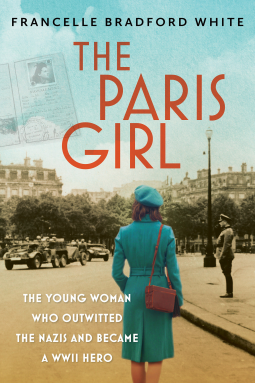
I just finished reading The Paris Girl: The Young Woman who Outwitted the Nazis and Became a WWII Hero. While it may not have been as captivating (for me) as the books I’ve mentioned above, I was drawn to the title and description of this book because of some family history of my own.
The Paris Girl is about a young French woman, Andrée Griotteray White, living in her hometown of Paris at the time of the German occupation of Paris during WWII. It was written by her own daughter, Francelle Bradford White, French through her mother and British through her father. White used her mother’s journals and diaries written from this time period, supplemented by discussions with her maternal grandparents, her mother, and her uncle, Alain Griotteray, who played a major role in the resistance movement.
Sadly, in her later years, Andrée suffered from dementia, and Francelle’s writing of her mother’s story may have been as much cathartic as it was altruistic, as part of the proceeds from the sale of this book go towards a charity supporting the care of patients with end-stage dementia. As a result, some of the information in the book leaves unanswered questions, and in her notes at the end of the book, the author does her best to fill in the blanks the best she can.
This is the story of courage, of patriotism so fierce that a very young woman, working in a police station under the very noses of German officers, will undertake secretive and dangerous activities for four long war-torn years while conducting missions and doing office work for the resistance. At times when reading this book I was struck at how mature and clever she was to evade capture, to carry – seemingly fearless – resistance propaganda around the streets of Paris, meeting with resistance workers at all hours, even becoming stranded in Biarritz late at night due to a delayed journey. Andrée tried multiple hotels and could find nowhere to spend the night. She ended up spending the night in a brothel, at the suggestion of a local police officer no less, where she awoke in the middle of the night having been bitten by fleas.
When in Bordeaux on one of her missions and she is brought in for questioning by the Gestapo, she keeps her cool under such immense pressure, questioning herself whether it was time to use the cyanide capsule sewn into the lining of her bra.
Conversely, there were passages in the book where Andrée is solely focused on what she can and can’t buy, such as her frivilous entry on May 19, 1940, when she had to work on a Sunday without pay but adds:
I went home for lunch today and wore my beautiful new hat. The designer is American and it is very large and a stunning navy-blue colour. I also bought myself a pair of navy-blue shoes which still hurt even though I have been wearing them for two weeks…
War-time life was much darker than some of these passages may portray. The author documents the shortage of food in Paris her mother experienced in late 1941, so extreme that
Andrée described eating several dinners of rat meat and beetroot, a vegetable she refused to touch for the rest of her life…Food rationing had come into force back in May: each person was given an allowance of 350g of meat (12.35 ounces, about a cup and a half) … per month.
I don’t read many books about war, even those told in memoir form, but this past summer my husband and I traveled to southwest France where my uncle’s name was added to a monument in honor of his service during WWII. He was recruited from the Army to serve with the OSS as part of a British unit and parachuted into an area near Cahors, France, on July 29, 1944, to aid the resistance efforts there.
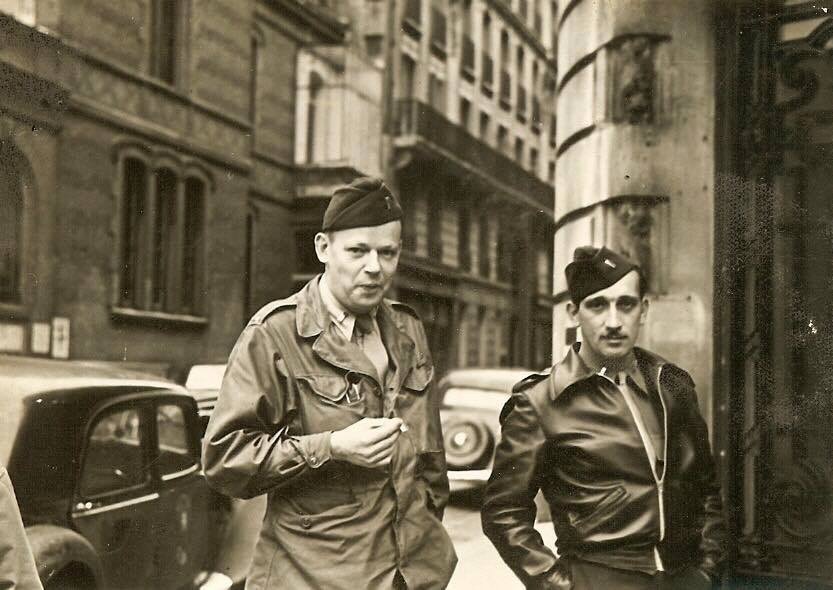
I was very close to him as he was married to my father’s older sister, and they lived very near me while I was growing up. I saw him daily, if not multiple times a week. He was my godfather and remembered me generously at key moments in my life such as high school graduation, and he made my first trip to Europe in 1973 possible, adding to my meager savings, so I could secure my spot on a student trip.
Reading this book, and learning of the dangers involved in Paris during this time, made me appreciate my uncle’s service all the more. How many close calls did he experience? How many horrors did he experience?
Like Andrée, my uncle received the Croix de Guerre. In 1995, Andrée also received the Legion d’honneur, the highest award given by the French Republic.
Thank you to NetGalley and Kensington Publishing for the ARC of this book. I enjoyed it and I learned quite a bit from it. I wish Francelle Bradford White much success in the sale of this book so she can give more to the charity she created for dementia patients.


 Michelle Blanchard Ardillo
Comment here!