


Monday, April 14, 2025:
Day 2 of Holy Week Reflections
“His standards are contrary to ours,” said Fr. Juan Pablo, one of the two young priests currently assigned to our parish, in a homily at daily Mass on Thursday, February 6, 2025, the memorial of St. Paul Miki and Companions, martyred in Japan in 1597. While St. Paul Miki’s companions were missionaries from the Philippines, foreigners in an anti-Catholic land, Paul Miki, a Jesuit priest, was a native Japanese, crucified on a cross on a hill overlooking Nagasaki, because he was evangelizing, spreading the Good News of Jesus Christ.
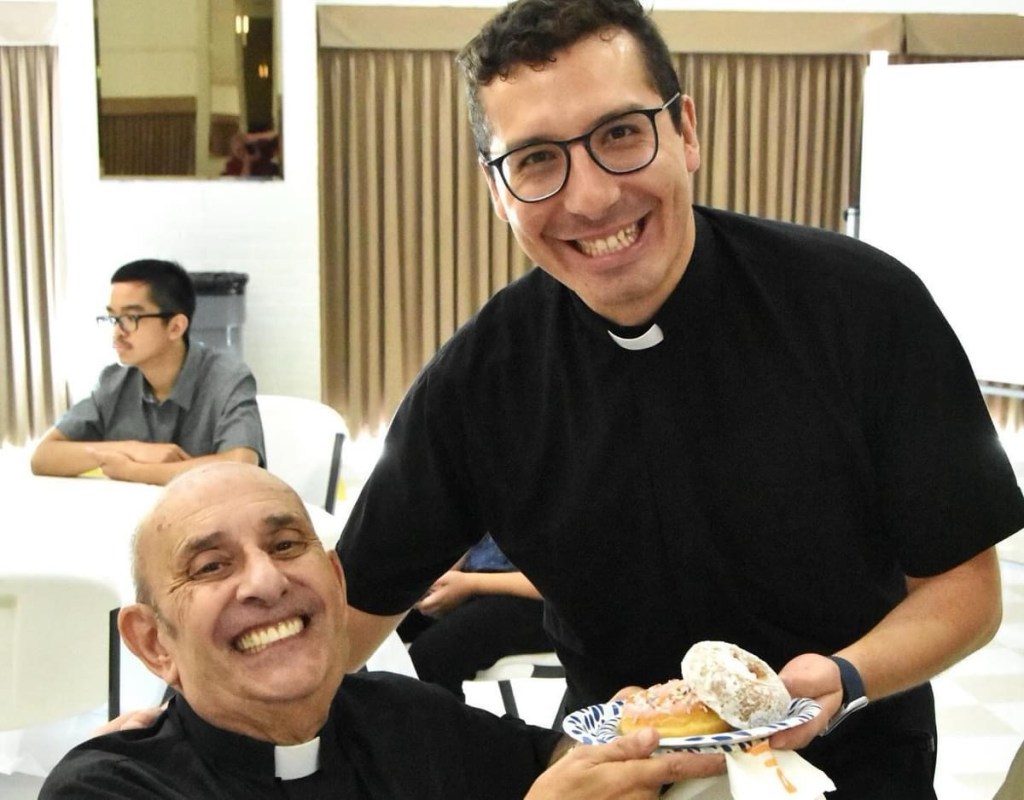
Rev. Juan Pablo Noboa, a native of Quito, Ecuador, is a breath of fresh air for our Church, for the priesthood, for our parish, the Shrine of St. Jude in Rockville, Maryland. He is always smiling, always positive, seemingly always full of energy, or is it the Holy Spirit?
Our other parochial vicar is Fr. Francisco (Kiko) Rodriguez, who—while a native of Newark, New Jersey—was born to missionary parents who came to the United States from their native Granada, Spain. He is quiet, but his homilies are bold and powerful. It is in the celebration of the Mass where he really shines. He and Fr. Juan Pablo are good friends, and they are often seen together about the campus.

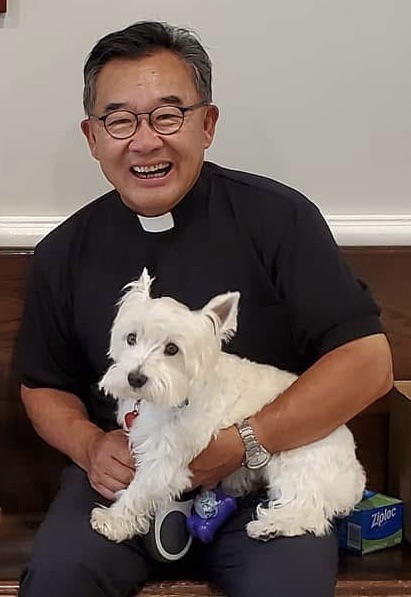
Our pastor, Rev. Paul D. Lee, STD, a Korean American, calls our church and our congregation “the beacon of Christ on the hill,” as our church is built on high ground overlooking a major highway, MD Route 586. Fr. Lee has been our pastor since 2012, but he had been assigned to our parish as his first parish after ordination in 1983, spending five years with us then. Fr. Lee is a scholar, an academic, an intellectual with many different languages on his tongue, however, he is also quick with a pun or a joke. He has been so good to our parish school, and has spearheaded many renovations across the parish and school campus. He can be seen every morning, walking the campus, greeting the children, with his adorable dog, Rocky.
As with our clergy, we are a parish of great diversity, with parishioners coming from over thirty different countries. We speak many languages: English, Spanish, Korean, Tagalog, Amharic, French, Vietnamese, and many tongues from the continent of Africa. Our Hispanic community is vibrant and very active, such that we have two native Spanish speaking parochial vicars, many bilingual services, and a Mass in Spanish each weekend.
Our parish school, St. Jude Regional Catholic School, shares this same diverse community, with children from all of those countries and more. The school’s annual International Day is the culmination of many months of study of foreign cultures, with each grade in preK through 8 studying one country during the school year. All year, students create art and learn music from their country’s culture, all on display on the day, and school families set up “booths” offering samples of cuisine from their homelands. The entire day is a testament to the diversity that thrives within the walls and hallways of SJRCS, and indeed, in the parish itself.
At the time of this writing, there is much talk in our country, in our government, in our communities, of who we are as a country. Immigration is a significant topic, with a division amongst the citizens of this great country as polarizing as the wall being built along our southern border. Government-funded programs supporting diversity in this country are being canceled, with many jobs being lost and many people from other countries—both undocumented and documented—living in fear of the future.
Yet, Fr. Juan Pablo’s homily on February 6th drove home a message where we can find hope and solace. His standards are contrary to ours. Fr. Juan Pablo used the example of school children choosing teams for a sport or activity. The strongest are chosen first, the weakest last. He shared that he was never good at sport, and while he was never chosen first, he was often chosen near the end. To coin a phrase that generated an acronym popular years ago, “What Would Jesus Do?”
Fr. Juan Pablo went on to talk about who Jesus did choose for his “team,” the stammerers, the cowards, the injured, the poor. He chose the weak first. He chose Matthew, a tax collector, to become one of his apostles. He ate with the poor and the unclean. He cured the sick, he called the children to Him. In the Gospel of the day, Fr. Juan Pablo read the words so familiar to us: “Jesus summoned the Twelve and began to send them out two by two to foreign lands and gave them authority over unclean spirits. He instructed them to take nothing for the journey but a walking stick,” to live among the people there (Mark, 6:7-13). Indeed, they traveled far and wide as they had been instructed, to Antioch, Rome, Greece, Ephesus, India, Ethiopia, Armenia, Lebanon, Cappadocia. They preached, they cured, they prayed, they were martyred.
His standards are contrary to ours. In a world that today “honors” billionaires and titans of industry above all else, that holds up professional athletes and celebrities as paragons to be praised and copied, what can we do, as children of God, as Jesus’s disciples here on earth, to do as He said, to do Corporal Acts of Mercy, to listen to and live by the words of the Sermon on the Mount? What can we do for the least of our brothers? How can we align our standards to His?
St. Paul Miki and Companions, pray for us.
 Michelle Blanchard Ardillo
Comment here!