


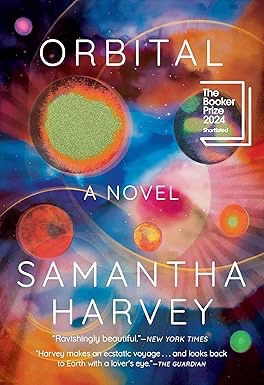
I’m not really sure what I want to say about this book. I finished it last night, but it took me much longer to read it than most books I read these days. Clearly displayed on the cover is the notice that it won the 2024 Booker Prize, a British award given to the best English-language book of the year published in the UK or Ireland, and the winners are mostly categorized as literary fiction. I will admit I’ve only read a handful of Booker prize winning novels, as well as another handful of those either long-listed or short-listed for the award. It’s not that I don’t like literary fiction, it’s just that I don’t always “get” literary fiction. Among the many nominees that haven’t yet won the Booker, I’ve read multiple books by both Anne Tyler and Elizabeth Strout, and they are two of my most favorite contemporary authors.
Orbital (Jonathan Cape/Grove Atlantic, 2023) by Samantha Harvey was featured in the Washington Post Book World, which is where I first learned of it. The brief write-up was so intriguing, four astronauts and two cosmonauts aboard the International Space Station, orbiting the earth, doing experiments, living in close quarters, it sounded fascinating. And, parts of this book are fascinating.
I really enjoyed the parts of the novel that served as character development for each of the six on the ISS, but those parts were short and few. Chie, one of the two female astronauts, is coping with homesickness and grief. It is palpable in its stark description. Shaun has a backstory involving he and his wife on their honeymoon meeting a Filipino family who called him “Buzz Lightyear” when they found out he was an astronaut.
But, in a “normal” novel, character development is only one part of the story. An important part, yes, but only one part, to be studied along with the plot. Orbital, however, has no plot. The closest thing to a plot is the occurrence of a giant typhoon barreling its way across a wide swath of land and water, which command central has asked the ISS astronauts to study and photograph. Otherwise, Orbital is long passages of beautiful prose describing the earth, space, space travel, loneliness, family, dedication, ambition, desire, and many other things. It is the beauty of the writing that won the Booker, no doubt.
While the ISS hurtles through space, it is the only thing moving at a fast pace. Which is precisely why it took me so long to finish this relatively short novel. The Kindle version I read is only 209 pages long, which includes the acknowledgements at the end.
So, in conclusion, I’m still not really sure what to say about this book. Is it beautifully written? Yes. Is it compelling? No. Should it be? I don’t know. The Booker committee thought so, and I suppose I will end with that. If you like literary fiction prized for the beauty of its prose, give Orbital a spin.
 Michelle Blanchard Ardillo
Comment here!