


At the start of each new year, I look back over the books I read the previous year and some years, I make a top ten list, not necessarily ranking them but always coming up with my favorite book of the year. Oh, boy, I will be having lots of trouble in January due to my recent reads!
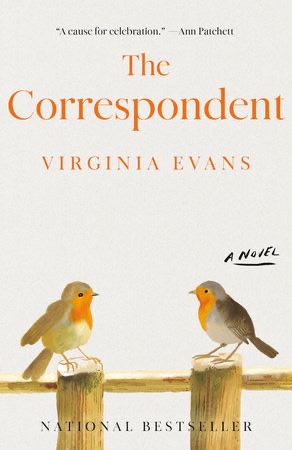
The Correspondent by Virginia Evans (Crown, April 29, 2025) will absolutely be on my top ten list for 2025, and at this point, it may very well be my favorite book of the year. I finished it on Sunday as my plane touched down at Dulles Airport returning home from an extended vacation. The landing was a bit rough but I was already quietly sobbing in my seat as I read the last few pages of this brilliant novel.
The Correspondent is a novel told in epistolary style, a narrative technique I fell in love with while teaching middle school literature in 2007. The book that started it all was Catherine, Called Birdy by Karen Cushman.
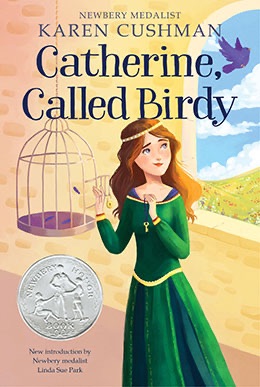
Once I started teaching this book, and exploring the method Cushman used to tell Birdy’s story, which was diary entries she was forced to write by her older brother who was intent in turning her into a “lady,” I sought other books written in epistolary style. If you are also a fan, here’s my list of some of my favorites (in no particular order) with their Goodreads links:
- https://www.goodreads.com/book/show/39832183-the-guernsey-literary-and-potato-peel-pie-society (so beautiful, such a good story, the movie was good but the book was better)
- https://www.goodreads.com/book/show/368916.84_Charing_Cross_Road (such a delightful book as well as the two others written by Helene Hanff, and yes, the movie was okay but nowhere as good as the book)
- https://www.goodreads.com/book/show/13526165-where-d-you-go-bernadette (loved this book, enjoyed the movie but the book was better, and I learned a valuable tool from the author’s other novel Today Will Be Different while reading it that I used in my classrooms almost daily)
- https://www.goodreads.com/book/show/227443.Bridget_Jones_s_Diary (rare instance where the movie was as good or better than the book)
- https://www.goodreads.com/book/show/58284121-love-saffron (on my list of favorites books of my entire reading life, see my review here)
- https://www.goodreads.com/book/show/18007564-the-martian (made me fall in love with sci-fi all over again, and yes, the movie is as good or better than this very good book)
I did a bit of research on the author Virginia Evans, and shockingly, this is her debut novel. That is absolutely astonishing to me. I mean, how do you follow up on that? I would really love to interview Evans, to ask her how she wove together this storyline using letters going back and forth between Sybil, the protagonist (FMC) and the recipients of her correspondence, which has been a lifelong habit of hers. For me, it was a perfect combination of facts, emotions, background, personal growth, intrigue, and so much more.
This book is already long-listed for the Center for Fiction First Novel Prize and the Andrew Carnegie Medal. I suspect there will be others to add to this list of awards in the coming months. In the nomination write-up for the Center for Fiction First Novel Prize, it captures much of how I felt about the book:
“…The Correspondent is a gem of a novel…It is about the hubris of youth and the wisdom of old age…”
It has been “blurbed” by some of my favorite authors: Elinor Lipman, Ann Napolitano, Ann Patchett, and others, and I shared many of their sentiments in the blurbs they wrote.
Sybil has devoted her personal life to the written word, because for her reading and writing are her two main practices. Yes, she was married, she gave birth to three children, she loves to garden, she attends church services regularly, and she loves taking care of her home on the waterfront in Arnold, MD, which is a small town near Annapolis, the state capitol of Maryland.
But, for Sybil, reading and writing matters the most to her. It is who she is to her very core. She thinks better on paper, in the old-school fashion of fountain pen and writing paper, which she special orders from England. Her relationships with the people in her life evolve through her correspondence to them, while not always reciprocated as she would desire.
She devoted her professional life to the study of law, the black and white of the law, the decision-making of the law, and while married for some time to a Belgian man, she absolutely 100% had a work husband, Guy, former law partner and eventually the judge for whom she left the practice of law to become his chief law clerk. And, that single-minded devotion to the law meant countless sacrifices she made along the way, primarily her relationships with her husband and her children.
As she hits her late seventies, she begins to realize just how much she has sacrificed, and much of the novel is devoted to her attempts to grab back at some of what she has lost. Not all, however, and it is a difficult pill she must swallow when she can’t make herself do the right thing.
Also at the core of this book is Sybil’s struggles as she faces the major challenge of losing her sight. With that major loss, she will lose those things most dear to her, her reading and writing, her lifelong habit of correspondence.
Sybil, in a lot of ways, reminds me of the character Olive Kitteridge, the main character in the eponymous Pulitzer Prize winning novel by Elizabeth Strout (yes, I know, if you read my essays regularly you will know (maybe sick of hearing) that Elizabeth Strout is my #1 favorite author). Just as Olive evolves and grows throughout book one and its sequel Olive, Again, so does Sybil in this book. Sybil thinks her life is over, she references her impending death many times in this book. She thinks the door to love is firmly closed and locked forever. She thinks she doesn’t need anyone new in her life, and has almost given up on having a healthy relationship with her daughter. She thinks of the mistakes she has made and feels there is no hope for forgiveness from the people she has hurt. But Virginia Evans so cleverly allows Sybil the grace to crack open those doors she had thought to be forever sealed shut.
This book resolves itself so well, and while it is sad in parts, downright heartbreaking in some, it is also written from a very sharp and witty perspective. My favorite is the letter that she writes to Mick Watts on March 13, 2013, very early on in the book (page 45 or so) where she writes:
“You also asked after the meaning of my practice of letter writing, calling it quaint and impractical (which was more telling of you, Mr. Watts, than it was offensive to me, though it was, still, offensive to me).”
Mick Watts had also expressed a very misogynistic opinion in his letter to her regarding part of her eulogy she gave at Guy’s funeral, and she responded in a postscript to that same letter:
“Postscript: A good punch line is a good punch line regardless if delivered by a man or a woman. You sound like an old fool with comments like that one.”
This review has been long and somewhat rambling, I think, but it is also what happens when I have deep thoughts about something I’ve read that I truly loved. This book will stay with me for a long time, and I hope I have learned from it, as I approach the same decade of life as Sybil. I hope I have learned the lessons Virginia Evans so cleverly laid out. I hope reading it will make me a better writer. I hope reading it will make me a better person. I look forward to whatever Virginia Evans pens in the future.

 Michelle Blanchard Ardillo
Comment here!