


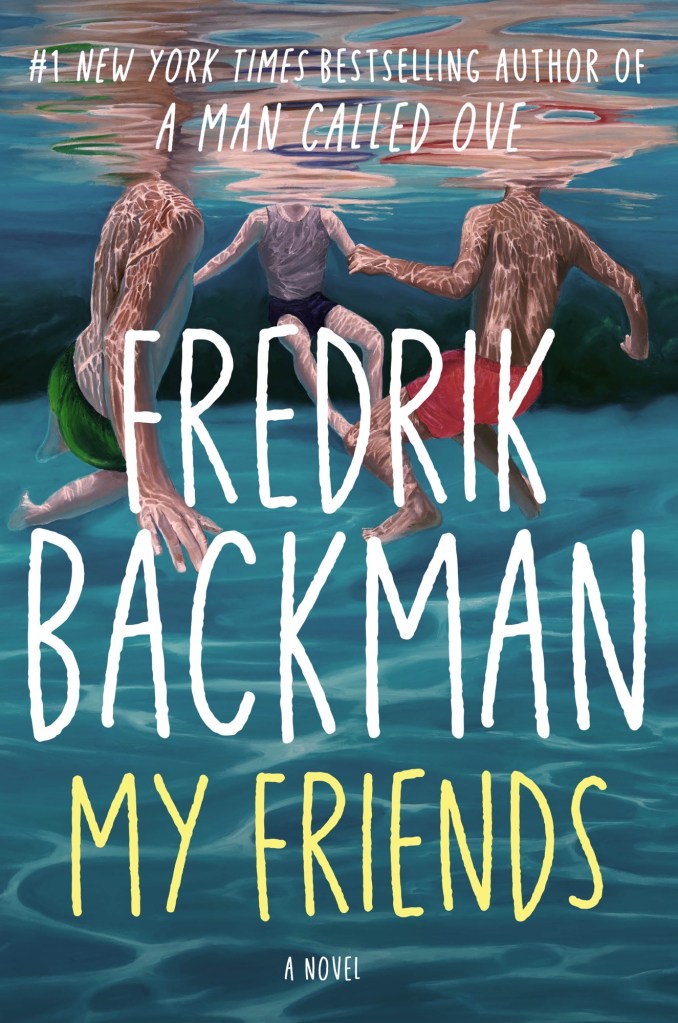
My Friends (Atria Books, May 6, 2025) is the second book I’ve read by Swedish author Fredrik Backman (translated by Neil Smith). In its almost two months since publication it has garnered a solid average of 4.52 stars in Goodreads with over 45,000 ratings and over 9,800 reviews. At this point, does it really matter what I think? Definitely not.
I seem to have two extreme levels of reading: (1) I’m either neglecting basic needs and family time to hide away reading the book I am reading, or (2) I am dreading going to bed at night knowing that the book that is open and unfinished on my Kindle is waiting for me. In category 1 you will find anything by Elizabeth Strout, AJ Pearce, Elinor Lipman, Ann Patchett. I’ll throw in Agatha Christie although I’ve pretty much exhausted her repertoire at this point.
In category 2, I’m going to put the beloved by many Fredrik Backman. I had to force myself to finish Backman’s first novel A Man Called Ove. Don’t ask me why I felt this way, it just wasn’t a book for me, or at least not for me at that time. Published in 2014, it has literally a million ratings on Goodreads with an average of 4.38. It was a commercial and critical success, with a successful movie in Sweden, and a remake in America starring Tom Hanks.
NetGalley offered me an ARC of My Friends, so I thought I should give Backman another try, since a dozen books have come from Backman’s pen since Ove. I finished My Friends last night, and I lay awake for a long time thinking about how I felt about this book. This morning, I’m still not sure.
Did I love it? Did I hate it? Honestly, I don’t know. I used to always know exactly how I felt about a book when I finished reading it, but lately, for whatever reason, I find myself not understanding how I can feel like I didn’t like a book at all, that I dreaded picking it up each time to read it, yet when I finished it, I end up giving it 4 or 5 stars. Can you explain that to me?
Yes, I gave My Friends 5 stars. And, yes, I really dreaded reading it every single time I picked up my Kindle. There are definitely things I loved about this book. To start off, it has some passages that are breathtakingly beautifully written. I’m not sure how that works when a work is written in Swedish and then translated into English. How can the person translating it make the prose as beautiful as what I assume the Swedish is? It’s for that reason alone that I always list the translator (or the illustrator for that matter) in my book reviews.
I loved the found family of the original four friends, the artist, Ted, Joan, and Ali. I love how Louisa (as well as Christian and his mom) is taken in by the original four because they know “she is one of us.” I know in my heart that I have rarely if ever experienced the bond that these four share. The reason is very simple. I had (have) a REAL family that I share that bond with. My childhood, adolescence, and adult life were not filled with pain and ugliness. I didn’t have to go outside of my family to find love and caring, absolute and true love. The scars of the original four, and Louisa, go far and beyond their outer shell. Those scars go so deep inside them, into their very DNA. It was heartbreaking.
This book should have giant stickers on the cover warning the reader about the content. Perhaps I am too sensitive, or I just can’t separate enough from the words on the page, but the poverty and abuse and hatred and ugliness of humanity were overbearingly difficult for me.
The counterbalance for all of that horridness is the beauty of their friendship, the original four friends. It was the beauty of the art being described, the way people who know absolutely nothing about art knew what the artist had created was something special, and even though they didn’t understand it, they knew the whole world would.
Taking the book apart bit by bit, I will say that the first 12% had me seriously thinking about marking it DNF and moving on with my life. But then, something shifted and I kept saying to myself, “Read a little more, it’s different now.” By the time I got to 72%, the first page of Chapter 43, I was tearing through it and read straight through to the end. Chapter 43 is a master class in the ugliness and the beauty of humanity.
For most of my life I have shied away from movies and books that I had predetermined would be painful or difficult for me. But, since joining NetGalley and being gifted ARCS to read and review, I have stretched myself in ways I didn’t expect. I think I am a better reader for it. And, perhaps, this is the exact reason why I had so much trouble making myself read this book. And, like any hard-fought battle that is ultimately won, perhaps that is why I gave this book 5 stars.


Comment here!