


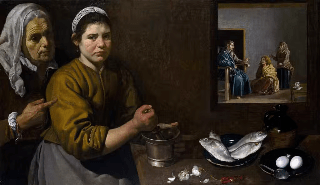
This past Sunday the gospel happened to be one that has always confused me, the story of Martha and Mary and their visit from Jesus. Our parochial vicar, Fr. Juan Pablo Noboa, gave me something new to think about in connection to this passage of scripture from the Gospel of Luke, Chapter 10, Verses 38-42.
Martha welcomed Jesus into their home and set about serving him. Mary, instead of helping her sister, sat near Jesus’s feet. Mary sat and listened to Jesus while Martha worked. Martha did all the work and Mary did nothing, or so it seems.
We’ve all been there; we’ve all been Martha. We’ve worked hard at something while someone else sat around and did nothing. We procrastinated on a rather big project and then we have to rush and run around like crazy to get it done. Or, we’ve volunteered (volun-told?) to do something no one else wanted to do, and then worked ourselves into a frenzy trying to get it done with not a single soul pitching in. Then, of course, we complain about it.
Or, conversely, we’ve been Mary. We’ve watched someone else sweat and stress over something and made only a vague attempt at helping, but in reality did nothing of consequence. We just didn’t want to do something, so we didn’t step up and volunteer in the first place. Or, maybe after working too hard for too long, we just want to “veg out” and lay around doing absolutely nothing. Insert pint of Ben & Jerry’s and Netflix.
It’s human nature, isn’t it, to be either Martha or Mary on any given day, depending on the circumstances. We are fooling ourselves if we think otherwise.
In 2007, as a new teacher, I often over-extended myself, volunteering to do things at school that no one else wanted to do. As a result, my own tasks were left undone, and no one stepped up to help me with those either. I would end up staying late, long after everyone else was gone—they were all eating dinner, chilling out, spending time with family—so I could get my own things done for the next day. How many days did I work alone in the school building, my only company being the nighttime cleaning crew? Did this make me a better teacher? No, not at all. Did it get me a raise or a promotion? Lol, maybe it endeared me to the admin, but certainly not a raise!
It took me years to figure out how to be a good teacher, being prepped and ready for each day of instruction, while still being able to volunteer to help with things around the school that needed support.
If I had to guess, and not being a biblical scholar I really don’t know, I would say that Martha was first-born and Mary was her younger sister. I’m also not sure where Lazarus falls into the birth order, but I will place him as the middle child, with a big sister looking after him and a baby sister being adored by everyone.
There are countless studies that analyze and document the personalities and behaviors of first-born children, and specifically, first-born daughters. They are often overachievers, conformists, rule followers, hard-working and highly disciplined. They grow up knowing they are the role model for their younger siblings, and they don’t want to disappoint their parents, who are busy raising those younger children.
When my mother was recovering from heart bypass surgery in 1993, we spent a lot of time together alone in a hospital room. She told me things about her younger years and shared feelings about motherhood and life in general like she had never done before.
We were laughing about the shenanigans that my younger brothers got into as they were growing up, and I commented that I had never gotten into trouble because I was terrified of breaking the rules. She responded that there weren’t any rules to break. I was taken aback and asked her what she meant. She said that I never asked to do anything, never asked to go out, never asked to stay out late, etc. I just assumed the answer was no and never asked. Somehow in my own mind I had created my own boundaries, my own rules.
In my first job after college graduation, I was hired as the receptionist at a busy law firm. Along with answering the phones, greeting visitors, and getting coffee for the attorneys and their clients, I also had to transcribe dictation tapes from one of the lawyers. I had never used a dictaphone system before, but I was a very good typist.
In theory, it wasn’t difficult to develop the skill. You put the headset on, pressed your foot on the little pedal on the floor, and typed away, easing off the pedal to pause the tape when you had to catch up or correct an error. In practice, though, it was a different story altogether. It was almost impossible to make any progress on the transcription of lengthy correspondence and legal documents with five telephone lines ringing off the hook and a constant stream of clients and visitors coming through the door of the offices, in the foyer area where my desk was located.
So, I stayed late everyday, after the office closed and the phones stopped ringing, to listen to the tapes and type their contents. When that didn’t help me stay caught up, I started coming to work earlier and earlier to get the tapes from the day before completed before the lawyers came in. It was a vicious cycle because the more work I produced, the more tapes appeared on my desk. Finally, the managing partner came in very early one morning and found me typing away. He was very surprised and asked why I was in the office two hours before the office opened. I explained it all to him, and he laughed. The tapes didn’t have to be completed each day. If they were a rush or critical, he would mark them as such, otherwise, I could take a few days to complete them. When all the tapes were done each day, he had assumed I didn’t have enough work so he started leaving more. Being Martha nearly wore me out.
In Luke’s gospel story, Martha was only doing what she thought was necessary to honor the presence of Jesus in their home. She only knew one way, probably the way she had always been, work hard and get it done, or in Nike parlance, “Just do it.” She was frustrated that Mary wasn’t helping her, perhaps she also wanted to sit at Jesus’s feet and listen to him, but then who would serve him? Who would prepare the meal? Who would clean up after?
Mary, on the other hand, perhaps, didn’t even realize that Martha needed help. I’m 100% certain that if Jesus appeared at my door, preparing a meal or serving him a cup of coffee would be the furthest thing from my mind. I know how I feel when I just meet a favorite author, like when I’m standing in line waiting for him or her to sign their new book I just bought. I am starstruck by the time I get to the table, and I sometimes have trouble saying anything interesting to this person whose work I love so much.
Some people are just oblivious to the fact that someone else is doing all the work and actually stressing over it. I’ve often had friends tell me that their husbands don’t help out around the house, and the excuse is always, “I didn’t even notice that pile of laundry” or something similar. They genuinely don’t notice the little day-to-day tasks that need attention. It doesn’t make them a bad husband or a negligent father. Conversely, they may be prioritizing what they think is more important than unloading the dishwasher, like reading to their toddler.
So, back to Fr. Juan Pablo’s homily this past weekend. He said that Jesus was telling Martha that Mary had chosen the better part because while Martha was working for Jesus, Mary was allowing Jesus to work through her. Just think about that for a moment.
Mary was focused on what Jesus was saying, what he was teaching, what he had to offer to her, instead of how Martha reacted to Jesus’s visit. She was focused on what Jesus needed, what she could do for him. Was Martha suffering from one of the seven deadly sins, pride? Was she so proud of her hostessing skills that she didn’t realize the importance of having Jesus in her home? Lawrence S. Cunningham wrote about the seven deadly sins for Franciscan Media’s St. Anthony Messenger: “The sin of pride is an exaltation of the self without recognition of the other.” Did Martha not recognize Jesus and the value of having the opportunity to sit at his feet and listen to him teach?
When my mother was very ill and at home with hospice care, my brothers, aunt, father, and I were all together in the apartment they had rented after Hurricane Katrina took their home. My dad was taking a shower and my brothers were outside on the porch talking, taking a cigarette break. My aunt really wanted me to go into the kitchen and have a cup of tea with her, to look at a stack of photos she had of a recent visit with her grandchildren. I really just wanted to sit next to my mom and be with her, while I still had her. I didn’t want to be busy or occupied elsewhere.
When I did eventually go into the kitchen with my aunt, that is exactly when my mom passed away. The hospice nurse told me that patients often do that, to spare their loved ones that moment when they let go and die.
The feast of Saints Martha, Mary, and Lazarus is this Tuesday, July 29, 2025. The July Magnificat has a reflection on this very gospel passage. It says that since the 3rd century, the story of Martha and Mary has been used to demonstrate the “relation between action and contemplation, ministry and prayer.” The gospel for that day is from John, 11:19-27. Once again Martha is the sister to take action while Mary sits at home. Martha goes out to find Jesus, to inform him of Lazarus’s death.

She says to Jesus, “Lord, if you had been here, my brother would not have died. But even now I know that whatever you ask of God, God will give you.” Jesus then brings Lazarus back to life. While Mary is at home in prayer over her brother’s body, Martha has gone out and taken action.
In Luke’s gospel passage, Jesus responds to Martha’s plea for Jesus to tell Mary to help her. He says, “Martha, Martha, you are anxious and worried about many things.” Why does he say her name twice? I can almost hear how he phrased this. The first Martha, a bit firmer than the second, the second said as almost a whisper. Perhaps shaking his head just a bit while saying it. It seems to me to be a gentle reprimand, a reminder of what is really important. Perhaps he is saying to her, “Come to me all who labor and are burdened, and I will give you rest.” (Matthew 11:28)


 Michelle Blanchard Ardillo
Leave a reply to Anonymous Cancel reply