


I just finished this book last night and I am truly impressed that this is a debut novel. The Three Graces of Pearl Street by Elizabeth Wellington Rollins is soon to be published by Atria Books, an imprint of Simon and Schuster, which is one of the “Big Five” of publishing. The Big Five is responsible for the most highly acclaimed and most trending of the lovely books that are sitting on your bookshelves, in the bookstores, and in the libraries.
If you don’t know about the Big Five, here they are briefly (without listing all of their individual imprints): Penguin Random House, HarperCollins, Simon & Schuster (yes, Simon as in Carly Simon’s father), Hachette Book Group, and Macmillan Publishers. To have a book published by one of these five giants in the literary world is quite the accomplishment! (If only…)
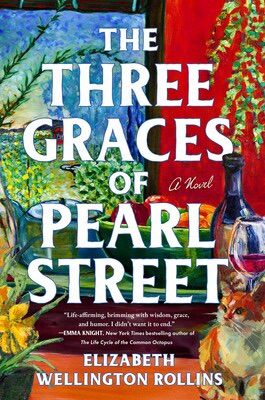
Thank you to NetGalley, the author, and Atria Books for the ARC ebook of this novel. I requested it after seeing the author herself on Instagram pitching her baby as it prepares to come out into this world.
Just two days ago I saw on the author’s Instagram that she had received a starred review from Library Journal, which is another huge thing in the book world—and for a debut novel!
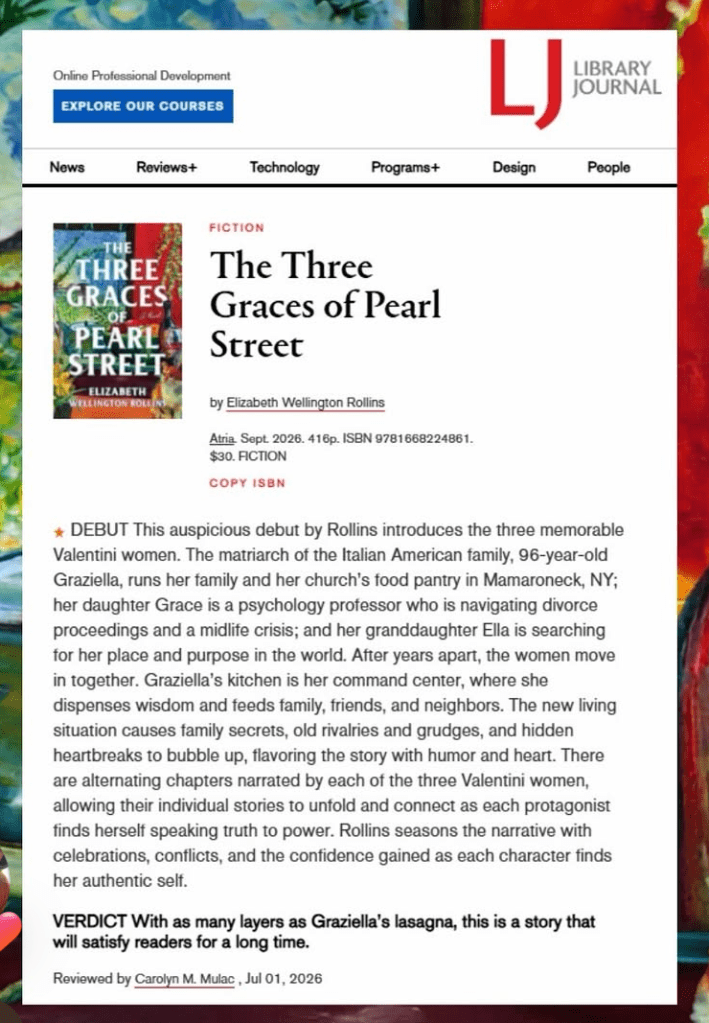
This is the description from the publisher’s website, which will serve to whet your appetite for this very appealing new novel:
In this wise and warm debut novel, an Italian American grandmother, daughter, and granddaughter all named after the Roman myth of the Three Graces find their lives—and their secrets—colliding when, after years apart, they come to live under the same roof.
Graziella, a ninety-six-year-old former nun, spends her days running the parish’s food kitchen, convinced it is her responsibility to keep everyone fed in their working-class New York neighborhood. Her daughter, Grace, a respected psychology professor, appears accomplished and composed, yet finds herself unmoored as her personal life falters. Ella—Graziella’s granddaughter and Grace’s daughter—is weary of defending her vegan diet and anti-capitalistic lifestyle; blind to her own brilliance, she longs, above all, for a place to belong. Living together again, the three Graces reckon with the distances that have shaped them, and with what it means, at last, to be fully known.
“Truly captivating” (Annabel Monaghan, New York Times bestselling author) and populated by unforgettable characters, The Three Graces of Pearl Streetexplores the delicate balance between tradition and modernity, and the quiet courage it takes to move through the world with true grace.
This book will make you hungry on many different levels: hungry for authentic Italian food cooked by a nonna in a sparcely outfitted 1950s kitchen; hungry for the close-knit family lifestyle of three generations of Italian Americans living together, cooking together, eating together; and hungry for the excitement that comes with self-discovery and true love.
It will also make you cringe, though, because along with all that togetherness comes a lot of bickering, bossiness, and flared tempers. This isn’t exclusive to Italians, I’ve known this to happen in Cajun families with every bit of tough love that can be dished out.
I really enjoyed this book. As I said, it’s hard to believe this came from a debut author. It was uplifting, heartbreaking, tender, fierce, warm, and real. For me the pacing was just right, and I loved that when the point of view changed from chapter to chapter, the character’s name was right at the top of the new chapter’s page. No guessing which of the “three Graces” was doing the talking. I thought it held together very well, and the resolution was very satisfying. This is a personal pet peeve, especially with very new authors as well as authors on their 5th or 15th novel (Dan Brown, I’m looking at you), when the novel just falls apart at the end, making it feel like you wasted a whole lot of your precious reading time for little return.
The author has done a great job of bringing NYC to life here, from the neighborhood where Graziella has lived all her life in the house where she was born, walking distance to St. Joseph’s and her beloved food pantry, to being deep in Manhattan at Columbia University where Grace teaches, to Brooklyn where Ella lives in a hippie-style commune. We also experience Grace’s cottage home with its spectacular garden near the neck of the Long Island Sound.
Author Rollins gives the reader insight into the life of a young person living with Type 1 diabetes, and how that disease, with which Ella had been diagnosed at the age of five, impacted every single aspect of her life. She had been taught at a young age what to eat and when, how to adjust her insulin intake, and how to spot when her blood sugar was dangerously low. This she handled with great maturity throughout the story.
Negatives? A few, but in the scope of things, I think they are minor. At 416 pages, I felt it was a little bit long. There was a lot of ground covered, telling the life story of three generations of woman in this one family, when truly each one of them could have had her very own novel.
Another thing that I found odd was the use of technology, or rather, the lack of it. The original of the three Graces, Graziella Valentino, is 96 years old, and at the beginning of the novel, she doesn’t even own a computer of any kind, yet she has been making investments since her husband died when granddaughter Ella was just a one-year-old. Graziella asks now 20-something Ella to teach her how to use a computer—at the age of 96–so I wonder if she had been making these investments by calling a stockbroker all this time?
Another thing that sort of nagged at me was how both mother Grace and daughter Ella were so insecure about themselves and their self-worth. These things eventually sort themselves out and it is very rewarding that these two otherwise very capable women finally go for what they want in life with the gusto that has been inherent in grandmother Graziella.
And finally, and this is very minor, I wish there had been footnotes with translations of the Italian being spoken. Yes, I figured it out based on context clues, but it was a break in the narrative for me.
Those things aside, I found this new novel to be well-written and engaging. All of the references to the Catholic faith hit home for me, although the showdown with the Cardinal seemed a bit outrageous.
But, THE FOOD! Every time either a pizza slice or lasagna or chicken cutlet (IYKYK) was mentioned, I yearned for a big ole’ Italian meal at my in-laws, the kind served to me on my very first visit 39 years ago to my then boyfriend’s house for Sunday lunch. Lasagna, meatballs and red sauce, spaghetti, Italian sausage, baked ham, fried chicken, Italian bread, fruit salad, and so much more the tables were heaving under the weight of it all. A house full of Italian American Catholics and meals started with Grace to bless the food and then “Mangia!”

UPDATE: I can’t stop thinking about this book and I’ve seen other people’s reaction to it as well! 5 star debut novel! Go read this one!


Comment here!