


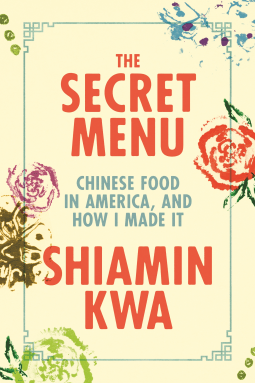
The Secret Menu: Chinese Food in America and How I Made It by Shiamin Kwa is more than a memoir. It is more of an anthropological study of the Chinese culture in America, where the author wasn’t Chinese enough for home and too Chinese for her new country.
In fact, the subtitle itself is somewhat of a metaphor: Kwa is trying to explain how she made it in America, while explaining how she makes Chinese food in America, two very different things but both make for an interesting study.
There is a lot of food talk in this book, and I do love reading about food. I really enjoyed when Kwa would take us down the Southeast Asia rabbit hole of something like a particular dipping sauce, explaining how it differed in Vietnam, Malaysia, Singapore, etc., sometimes differing in just a small amount of one ingredient. The recipes that are sprinkled throughout made my mouth water more than once.
For me, however, this book was very dense, and a very slow read, and I am going to attribute that to the fact that the author is a highly educated college professor and highly regarded in academia. She teaches at Bryn Mawr and has a M.A. and a Ph.D. in Chinese literature from Harvard, with a B.A. from Dartmouth.
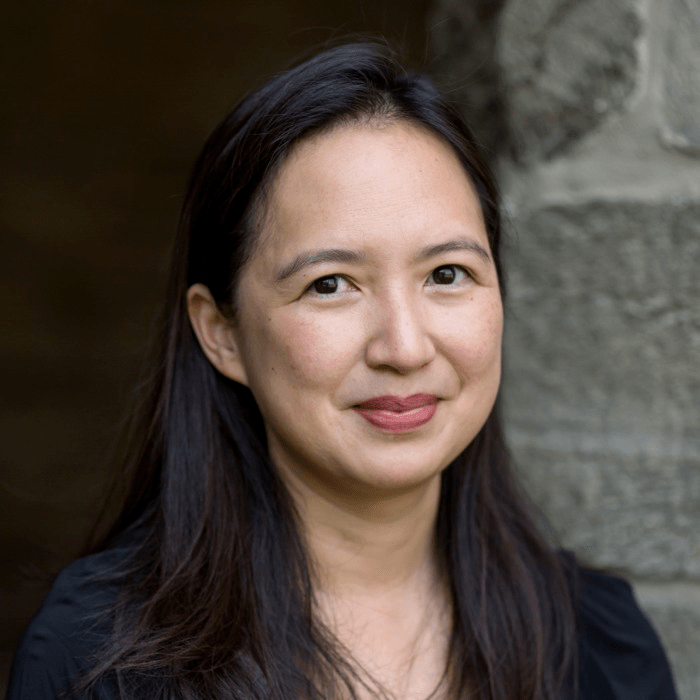
Shiamin Kwa is Professor of East Asian Languages and Cultures and Comparative Literature at Bryn Mawr College. She received her M.A. and Ph.D. in Chinese Literature from Harvard University and her B.A. in English Literature from Dartmouth College. The Bryn Mawr website says this about her,
Her written work explores relationships between form and content, text and image, self and self-presentation, surface and depth, and the conflicts between what we say and what we mean. Her research interests include theater and fiction, food studies, graphic narratives, literary studies, cultural studies, comparative and world literature, and literary and narrative theory.
One of the things I found very interesting in this book is Kwa’s thoughts on appropriation of the foods of other cultures. I have very strong feelings on this. Kwa writes:
I have nodded in agreement when someone accuses another person of eating or cooking a food that they are not entitled to: How dare they make pho when they are not Vietnamese? But then again, am I Vietnamese? When I give in to those baser feelings, I am giving in to reifications, making a dish of food stand in for more abstract concepts like virtue and shame, inclusion and exclusion. Exclusion is wrong, but not the bowl of soup. I need to be able to see that, and I need to be able to adopt a broader vantage point if I want to see. I want always to remind myself that we can look at things from far, far away, and be better able to notice the connections that emerge from the benefit of wide expanses. We can look ahead. That’s the bird’s eye view that I want to chase.
One of the things I love most about travel is tasting foods of other cultures and cuisines, whether it is domestic or international travel.
On a trip to Gettysburg decades ago I had the special of the house in the small diner where we ate lunch: broasted chicken. I had never heard of “broasted” chicken but I wanted to try it the minute I saw it on the sign outside. It was delicious.
On our trip to Portugal last fall, we ate pastel de nata at each and every opportunity. The small custard tarts were soft and creamy while the outside was crispy, flaky, and otherworldly. We also were told about the local street food Prego, which is a crusty roll stuffed with roast pork. No adornment, just bread and pork. Nothing else was needed, not a condiment in sight.
On occasion, I have come home from my travels and attempted to recreate the dishes I loved from distant places. I don’t consider this appropriation of a culture that is not mine; I consider it an homage to a culture that I experienced and enjoyed. For example, the viral recipe for a Korean cucumber salad was on everyone’s social media a few summers ago. I made it dozens of times, with different twists on the recipe. Kwa gives us her version, and I look forward to trying it as well.
To me, these are the things that make learning about other cultures fascinating and so interesting. That is one thing I enjoyed in Kwa’s book. Bouncing back and forth between Malaysia and America, she experienced both cultures while growing up and never felt quite at home in either place.
This was an interesting read, a bit more textbook than memoir, but very enjoyable. Thank you to NetGalley, the publisher Farrah, Straus and Giroux, and the author Shiamin Kwa for the ARC ebook.


Comment here!